Live Dream Catcher Casino UK: How It Works
 Available in GB
A streamed dealer and an electronic betting interface bring the physical table to a remote screen, with important limits to that comparison.

Table of Contents
- How a Live Table Reaches the Screen
- Dream Catcher in the Live-Casino Context
- What a Casino Offer Means at a Live Table
- The Mechanics Behind Live Casino Play
- A Physical Wheel, Different Odds
- What a Live-Casino Site Can—and Cannot—Tell You
- Demo Play: A Limited Rehearsal
- Reading a Live-Casino Review Closely
- The Pace and Conditions of Playing Live
- Choosing a Casino Without an Empty Ranking
How a Live Table Reaches the Screen
A live-casino table is not simply a digital game dressed to look like a room. Its central event happens elsewhere: in a studio, where a human dealer conducts play in real time. A camera carries that scene to the player’s screen, while an on-screen interface provides the means to place bets. The result joins two different kinds of activity: physical dealing in one place, and decisions made through software in another.
That division matters. In a fully digital game, the action is generated by a computer. In a live dealer game, the visible dealer and the events at the table are part of a streamed broadcast. The screen is therefore both a window and a control panel. It shows the unfolding play while presenting the choices available to the person watching.
The arrangement can make remote gambling resemble a visit to a casino, but resemblance is not the same as presence. The player is not at the studio table, and the dealer is not responding to a roomful of people in the ordinary way. The interface mediates the encounter. A bet is submitted electronically; the dealer’s activity is seen as it happens. The screen performs a small social trick, bringing a human figure into a space otherwise made of buttons, balances and changing images.
There is a history of aspiration in that trick. Casinos have long sold more than the possibility of a win: they have sold atmosphere, ceremony and the sense that an event is taking place in company. The live stream borrows some of those signs. A dealer handles the game; a camera gives the action a visible setting; the interface translates the viewer’s intention into a bet. Yet the underlying relationship remains remote, and the screen keeps its own quiet authority. It decides what can be seen and how an action can be entered.

For someone looking for Dream Catcher in an online casino, the word “live” points first to this delivery method. It describes a kind of online play in which a studio broadcasts real-time action and bets are placed through an interface. It does not, by itself, establish what any particular game contains or which operator offers it. Those are separate questions. The distinction is useful because a familiar title and a live stream are not interchangeable descriptions: one concerns the game being sought, the other the way play reaches the screen.
The same distinction applies to searches for a UK casino offering a live version of a named game. A result may be presented as a live-casino option, but the label does not settle whether the operator is authorised to serve customers in Britain. In the United Kingdom, live dealer casinos are legal when they hold a licence from the UK Gambling Commission. Licensing is not decorative text in a footer; it is the condition that separates a legal service for UK players from one that is not operating under the British regulatory framework.
That condition reflects a wider British approach to remote gambling. The table may be in a studio, the customer at home and the software operated across a network, but distance does not remove the operator’s responsibility to hold the relevant UK licence when serving the market. The physical location of the cameras does not turn regulation into an optional extra. A stream crosses borders easily. Permission does not.
Licensing
In the United Kingdom, live dealer casinos are legal only when they hold a licence from the UK Gambling Commission. Operating without this licence means the service is not under the British regulatory framework.
The streamed format also changes the texture of attention. A player is watching a sequence unfold rather than receiving only a result generated on a screen. The dealer’s gestures and the table’s visible activity give the game a human rhythm, while the interface keeps the act of betting separate from the person dealing. That separation is easy to overlook because the two are presented together. One is performance; the other is transaction.
There is a modest theatre in the arrangement, and a practical machine beneath it. The studio supplies the scene. The software carries the picture and accepts bets. The player watches through a screen that joins those functions without making them the same thing. Live play is therefore not a return to the casino room so much as a carefully assembled likeness of one, delivered through a regulated online service.
The likeness has limits. A broadcast cannot put a player at the table, and a familiar name cannot prove that a particular live version is available. What it can do is make remote play feel less abstract: a real dealer acts in real time, while the interface turns a viewer’s choice into a bet. For any online gambling, the content here is for entertainment purposes only, not gambling advice.
Dream Catcher in the Live-Casino Context
Choosing a live Dream Catcher casino in the UK involves more than finding the game: it is also worth considering how quickly winnings are paid out. This list gives you a concise reference point for that detail.
Payout speed: 1-3 business days WinBeast lists a payout speed of 1–3 business days.
Payout speed: 1-3 business days SpinFormula lists a payout speed of 1–3 business days.
Payout speed: 1-3 business days EvoSpin lists a payout speed of 1–3 business days.
Payout speed: 1-3 business days Britsino lists a payout speed of 1–3 business days.
Payout speed: 1-3 business days Amunbet lists a payout speed of 1–3 business days.
Payout speed: 1-3 business days BeOnBet lists a payout speed of 1–3 business days.
Payout speed: 1-3 business days Chanze lists a payout speed of 1–3 business days.
Payout speed: 1-3 business days Dieselwin lists a payout speed of 1–3 business days.
Payout speed: 1-3 business days NightLuck lists a payout speed of 1–3 business days.
Payout speed: 1-3 business days NightWin lists a payout speed of 1–3 business days.
Dream Catcher is a name that may appear in searches for live casino games in the UK. The wording suggests a particular title and a particular way of playing: a live presentation rather than a purely digital game. But a name is not a rulebook. It cannot, by itself, establish how a game works, what choices are available, or whether a particular casino currently offers it.
That distinction matters because casino pages often place a game name beside familiar labels such as “live”, “online” or “real dealer”. Those labels describe a broad category, not the details of an individual game. A live-casino result may point towards a table streamed from a studio, but the word “live” does not settle what happens on screen or how a round is decided. Nor does the word “casino” in a title confirm that the same game can be found at every casino serving the UK.
The phrase “Dream Catcher casino” can therefore mean several things in ordinary use. It may refer to someone looking for the game itself, for a casino that carries it, or simply for an explanation of what the name denotes. These are related interests, but they are not interchangeable. An account of live casino play in general can explain the setting; it cannot fill in game-specific details that have not been established.
This is where restraint becomes useful. It would be easy to borrow rules from another game, infer a format from the title, or describe imagined features as though they belonged to Dream Catcher. None of those moves would help someone deciding what a screen actually contains. The more responsible description keeps the boundary visible: the name can identify the subject of interest, while the rules, available actions and presentation require their own clear explanation.
The same caution applies to availability. A search for Dream Catcher live casino UK expresses an intention; it does not prove that a particular UK-facing casino offers the game at the time someone looks. Casino catalogues can differ, and a page carrying a title is not necessarily evidence that the game is accessible there now. The practical question is not merely whether a name appears in a result, but whether the operator’s own current information identifies the game and explains its terms.
The live format also has a different rhythm from a digital version. Live games move more slowly, can have higher minimum bets, and depend on a stable internet connection. Those conditions shape the experience before any game-specific rule comes into view. A slower pace gives the screen time to show proceedings as they happen, but it also means that a session is not necessarily as quick as clicking through a digital game. The connection is part of the table. So is the minimum stake.
- Ensure a stable internet connection
- Set a stake that fits your budget
- Read the game’s own instructions
- Assume the live format suits all circumstances
- Substitute general live play conditions for specific rules
- Guess features not explained in the description
That matters when the title itself is unfamiliar. A player who knows only the name may still need to distinguish between the general conditions of live play and the rules of this particular game. The first concern is whether the live format suits the circumstances: a steady connection, a willingness to play at a measured pace, and a stake that fits the budget. The second is whether the game’s own instructions make its structure understandable. One cannot substitute for the other.
There is a small cultural oddity in the way casino names travel. They can become shorthand for a whole experience, even when the name tells little about the arrangement behind it. A search term may compress the game, the casino and the live setting into a few words. The screen then has to separate those meanings again. Labels are efficient; explanations are less so.
For anyone interested in Dream Catcher as a live-casino title, the sound approach is to treat the name as a starting point rather than a promise. Look for a direct description of the game and its rules, rather than assuming that a familiar live-casino label supplies them. Confirm that the listing refers to the intended title, and keep general live-play conditions distinct from details specific to the game. Where the information does not explain a feature, there is no need to guess at it.
A live setting can suggest immediacy, but it does not make a title self-explanatory. The distinction is plain, if not especially glamorous: the name raises the subject; the rules make it legible.
What a Casino Offer Means at a Live Table
A welcome offer can look generous in a headline and still have little to do with the game that brought someone to a casino. The distinction is between the advertised reward and the conditions attached to it: what games can use the offer, and how much each game contributes towards any wagering requirement. For live play, that difference matters more than the size of the banner.
A specialist review of UK promotions describes many welcome offers as free spins for slot games. Those spins cannot be used at live tables. A player drawn to a live casino therefore may find that the most conspicuous part of a welcome package applies elsewhere on the site, not to the table they intended to play. The offer is not necessarily misleading; its relevance depends on its terms. But relevance is not the same as visibility.
The same separation applies when an offer includes a bonus balance that can be staked on several kinds of games. Live games may count for only a small share towards the wagering requirement. A weighting of 10%, for instance, means that a stake contributes only a fraction of its face value to the qualifying total. The balance can appear to be available while progress towards completing the terms moves slowly. A slot game and a live table may therefore treat the same bonus funds very differently.
Wagering Weighting
A weighting of 10% means that a stake on a live game contributes only a fraction of its face value toward the qualifying total for a bonus.
That is the quiet arithmetic behind the word “best”. A casino offer cannot be judged for live play merely by its headline value. If the reward is restricted to slots, it has no direct use at a live table. If live games are permitted but carry a low weighting, the offer may be less useful than it first appears. The relevant question is not whether a promotion looks large, but whether its rules fit the intended play.
Promotional language tends to place the prize in the foreground and the conditions in smaller type. The arrangement is familiar beyond gambling: the gift is easy to picture, while the obligations arrive as a footnote. In a casino, that footnote can determine which games qualify, how wagering is counted and whether some play contributes at all. Terms are not decorative legal furniture. They define the offer.
A careful comparison begins with eligibility. The promotion’s terms should state whether live games are excluded, permitted, or subject to a weighting. They should also explain any wagering requirement and maximum bet limits. These conditions can change the practical value of an offer without changing its headline. A bonus advertised as flexible may still be tightly directed by the rules governing its use.
There is also a difference between being allowed to play a game with bonus funds and having that play count fully towards a wagering requirement. These are separate conditions. A live game might be accessible while contributing only a small proportion of the required progress. Confusing access with full contribution can make the terms seem more generous than they are. The detail is decisive.

For someone seeking a live Dream Catcher table, the best-matched promotion may be no promotion at all. That is not a claim that bonuses have no value; it is a recognition that value depends on fit. A slot free-spin package may suit someone planning to play slots, while offering nothing to someone interested in a live table. A bonus that permits live play may still be less useful if its weighting makes progress slow. The same offer can be attractive in one context and irrelevant in another.
This is why a supposed ranking of the best Dream Catcher casinos cannot be reduced to a welcome offer. The promotion alone does not establish whether a site offers the desired game, nor does a prominent bonus tell much about how live play is treated under its terms. Those are different questions. A bonus comparison has a narrow job: to show what the reward permits and how its conditions affect play, not to turn a headline into a verdict on the entire casino.
The word “best” carries a promise of fit. In this setting, fit means that the offer is usable for the chosen kind of play and that its qualifying rules are understood before opting in. If a live game is excluded, the answer is plain. If it is included with reduced weighting, the apparent value needs to be read alongside the requirement. If the terms are unclear, the headline cannot settle the matter.
Evaluating a Bonus
- Check if live games are permitted or excluded
- Verify the wagering requirement percentage
- Identify the game weighting for live tables
- Review maximum bet limits for bonus funds
That leaves a less dazzling but more dependable measure: the small print in full. It shows whether a welcome offer belongs at a live table, or merely sits beside one in the same casino.
The Mechanics Behind Live Casino Play
Blackjack has a spare objective: make a hand worth more than the dealer’s without going over twenty-one. The arithmetic is simple; the decisions are not. A live table adds a human presence to that familiar contest, making the deal visible as it happens rather than reducing it to an animation or a sequence of prompts.
The dealer handles physical cards from a standard deck and conducts the hand in real time. Players can see the dealer and interact with them, while the game’s on-screen controls carry the decisions and bets. That combination belongs to a long tradition of gambling as both calculation and performance: the cards determine the result, but the ritual of dealing gives the result its public face. The screen has not abolished the table. It has moved it.
Some tables provide chat, allowing messages to pass between players and the dealer. Its role is social rather than mathematical: a greeting or comment does not alter the cards or the rules. Even in a shared digital room, the central action remains tightly ordered. Cards are dealt, decisions are made, and the hand concludes under the table’s stated conditions.

Side bets add another route for staking alongside the main hand. Their presence does not change blackjack’s central aim, and their terms may differ from the rules governing the main wager. Bet Behind, where offered, allows a player to place a wager on another player’s hand rather than taking a seat in the action themselves. The distinction matters: the hand is someone else’s to play, even though a separate stake follows its outcome.
These additions can make the table feel busier, but they do not make its underlying mathematics more favourable. Blackjack retains a house edge. A staking system such as Martingale—raising the next stake after a loss in an attempt to recover it—cannot remove that edge and can still lead to losses. A pattern of changing stakes is not a way to command the cards. The arithmetic does not yield.
Table rules and the paytable are therefore part of the game, not decorative material around it. They define how the particular table handles its options and outcomes, and should be understood before play begins. A side bet can be especially easy to mistake for a small variation on the main hand when it is, in fact, governed by its own terms.
The mechanics also explain why a live blackjack table is not interchangeable with a search for a named live game. A title may attract attention, but the practical questions at a blackjack table concern the hand, the dealer’s actions, and the rules attached to each wager. The name on the screen cannot substitute for reading those rules. Nor does interaction make the result predictable: it makes the process visible.
Attention: Staking systems like Martingale cannot remove the house edge and can still lead to losses.
Live play remains gambling, not a method of earning. A budget set in advance gives the session a boundary; the dealer, chat and side options do not change that boundary or guarantee an outcome. This is entertainment, not gambling advice. The cards keep their own counsel.
A Physical Wheel, Different Odds
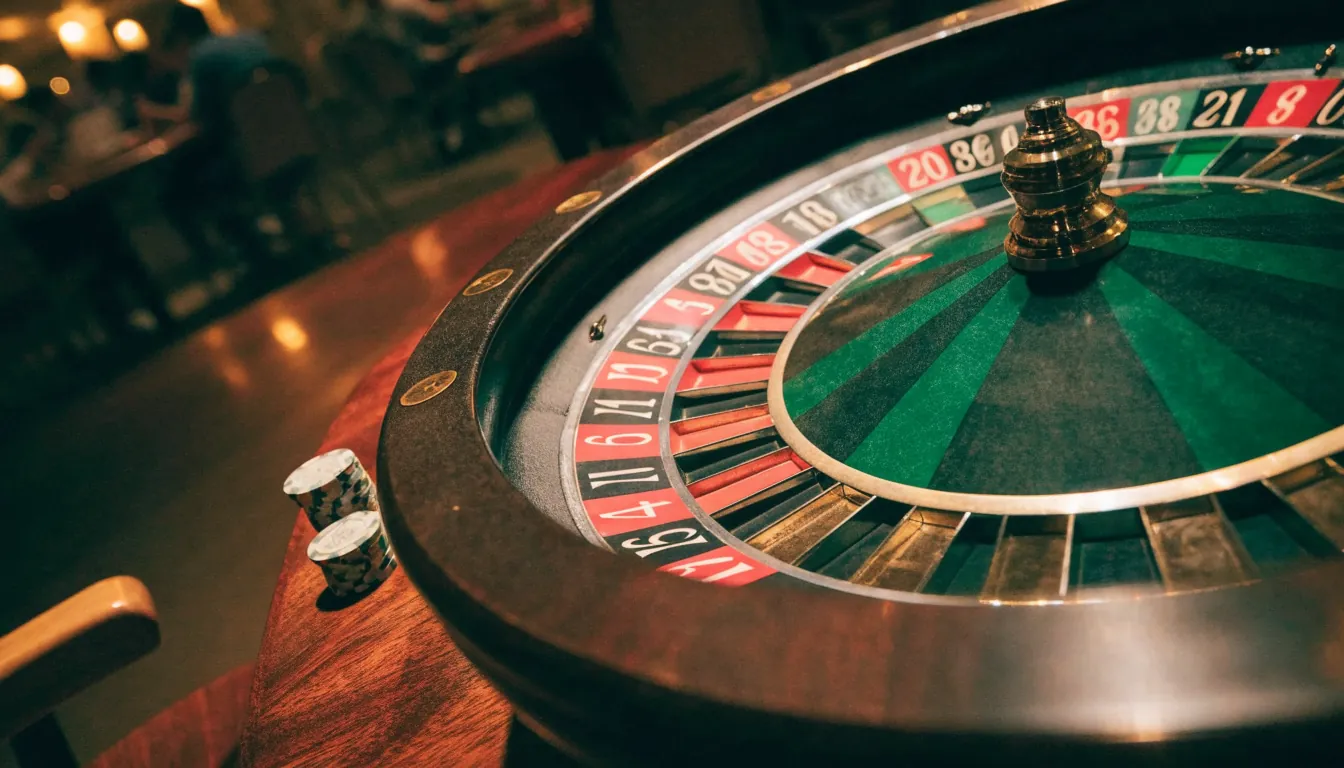
A live roulette wheel has a material presence that a digital version does not: a dealer sets the wheel turning, and a ball travels around its rim before settling into a numbered pocket. Computerised roulette replaces that visible mechanism with a Random Number Generator. The player still selects a number or another betting option, but the result comes from software rather than a ball in a studio.
The distinction is not simply theatrical. A physical wheel makes the sequence of events visible; a computerised game presents the outcome without that mechanical ritual. Neither format changes the basic wager: the ball lands on a number, and a straight-up bet wins when that exact number was selected. The wheel is a small machine carrying a large symbolic burden. Chance, made visible.
Its layout matters more directly. European Roulette has a single green pocket, marked zero. American Roulette has two: zero and double zero, or 00. That extra pocket changes the odds of a winning number bet: the chance is one in 37 on the European layout and one in 38 on the American one. The difference is built into the table, not hidden in the dealer’s handling of the wheel.

The house edge also varies by bet. A straight-up wager carries a 2.9% house edge, while other roulette bets carry a 2.7% edge. These figures describe the game’s long-run mathematical advantage for the house; they do not predict the next spin. A run of results cannot make a particular number due, and a record of earlier outcomes does not alter the next wheel’s probabilities.
French Roulette changes the effect of zero on an even-money bet. If the ball lands on zero, the stake is lost only in part rather than in full. That rule softens the result for wagers such as red or black, odd or even, but it does not remove the house edge. It is a small concession written into the rules: the green pocket still matters, just less harshly for that class of bet.
A roulette wheel may therefore refer to two different things in casual conversation: the physical apparatus used in live play, or the numbered arrangement that defines the game’s possibilities. A search for a Dream Catcher casino wheel should not blur those meanings. Roulette’s wheel and a game named Dream Catcher are not interchangeable descriptions, and the mechanics of one cannot establish the rules or availability of the other. The distinction is worth keeping. A familiar shape is not proof of a familiar game.
What a Live-Casino Site Can—and Cannot—Tell You
A casino site can show the conditions under which its live tables operate; it cannot make those conditions uniform across the market. Live play moves more slowly than digital games, because events unfold in real time rather than being resolved by software alone. That difference affects the feel of a session and the number of decisions or rounds that fit into it. A site can describe its tables, but the pace is part of the format.
Table Stakes
Minimum stakes vary between games; for example, some live roulette and baccarat tables may start around 20p, while blackjack often starts higher.
Minimum stakes are another practical distinction. Live tables can require more to join than digital versions, and limits may differ between games and tables. A specialist review has reported starting stakes around 20p for many live roulette and baccarat tables, with blackjack often starting higher. That is a report about tables it reviewed, not a dependable price tag for every casino. Limits can change, so the table’s own displayed terms are more useful than a broad comparison.
For someone looking for a casino that offers Dream Catcher, the site’s game catalogue is the place to establish whether that title is available there. A page about live play, or a general description of a casino’s tables, does not by itself confirm that a particular game is offered. Availability should be read as a specific, changeable detail, not inferred from the site’s branding or from the presence of other live games.
Connection quality also belongs in the practical assessment. Live games rely on a stable internet connection; interruptions can make a real-time session difficult to follow. A site may provide technical information, but the actual experience also depends on the player’s connection and device. The table is live; the network is not made reliable by a polished lobby.

These details help distinguish a usable option from a merely appealing description: listed games, visible table limits, and clear information about connection requirements. They do not establish that a site is best for every player, nor do they settle what a particular table will cost or whether a named game will remain available. The small print still matters.
Demo Play: A Limited Rehearsal
A demo can make a live-casino game feel less like a commitment and more like a rehearsal. It may offer a way to become familiar with an interface or watch how a live table unfolds without staking money. But “demo” is not a promise of a particular format, and the word alone says little about what a game will let someone do.
That distinction matters when looking for a Dream Catcher demo. A title appearing in a casino’s live section does not, by itself, establish that a free-play version is available. Nor does a demo label reveal whether the experience uses a live stream, how its controls work, or whether access is restricted. Those details need to be stated by the operator rather than supplied by assumption.
Free play is rehearsal, not a second route to a payout. Any balance or result shown in a demo should not be treated as money that can be withdrawn, and simulated play cannot guarantee that the same experience will be available at a real-money table. The boundary is simple, though interfaces can make it look less so.
Demo Limitations
Any balance or result shown in a demo is simulated and cannot be withdrawn, nor does it guarantee the same experience at a real-money table.
A live casino brings human dealing and an on-screen betting interface together. A demo, where offered, may help with the second part: learning where controls appear and how a session is presented. It cannot be taken as evidence of the precise pace, availability or conditions of real-money play. The resemblance may be useful; it is not identity.
There is also a small social fiction in the demo. The screen can stage the familiar rituals of a casino while removing the consequence that gives a wager its weight. That distance may help someone decide whether the format is appealing, but it should not be mistaken for practice that makes a later outcome predictable. Random results do not become more obedient through rehearsal.
Before trying any free version, its terms should make clear whether it is genuinely a demo and what happens to any displayed balance. If that information is unclear, the label has done less work than it appears to. A cautious reading is more useful than treating the word “free” as a full description.
A limited rehearsal, then. Not a preview of winnings, and not proof that a particular live game can be played without staking. This content is for entertainment purposes only, not gambling advice.
Reading a Live-Casino Review Closely
A useful live-casino review makes the rules visible before it offers an opinion. That sounds modest, but rule summaries are where a page either earns its space or merely decorates a verdict. A table’s name and appearance cannot explain what a bet means, how a round is resolved, or which outcomes pay.

For a review concerning Dream Catcher, the distinction matters. The title alone does not establish the game’s rules, paytable or availability. A careful account should separate what it has confirmed from what it cannot describe, rather than borrowing details from another live game and letting the resemblance do the work. A search for a Dream Catcher live casino review may bring up confident language; confidence is not a substitute for a stated rule.
Paytables deserve the same attention as instructions. They show what a winning selection returns and make the relationship between a stake and a possible payout legible. A review that praises a game without explaining its payout information leaves a basic question unanswered. Where terms are unfamiliar, plain explanations matter more than a parade of technical labels.
Baccarat offers a useful illustration of why rules cannot be treated as interchangeable. In standard Baccarat, a bet can be placed on Player, Banker or Tie. The aim is for the Player or Banker hand to finish closer to nine; both hands receive two cards, and a third may be dealt according to the totals and the game’s rules. Those details belong to baccarat, not to every live table. A review should identify the game it is describing and keep its explanations attached to that game.
The same discipline applies to differences between tables. If a rule changes what counts as a winning outcome, or a paytable gives different returns for selections, the review should say so clearly and point to the relevant information. Otherwise, broad assurances such as “easy to understand” have little substance. Easy for whom, under which rules?
- A game’s title does not establish its rules or paytable
- Paytables should be read to understand the relationship between stakes and payouts
- Rules are game-specific and cannot be treated as interchangeable between different titles
- Table rules are the record of how the game works and should be read in full before play
Before play, the table rules and paytable should be read in full. That is not ceremonial fine print: it is the record of how the game works. This page is for entertainment purposes only, not gambling advice. A review can clarify information; it cannot turn uncertainty into certainty.
The Pace and Conditions of Playing Live
The difference between a live table and a digital game is felt in the interval between actions. A live game moves at the dealer’s pace, not at the speed of a button press. Cards, decisions and the next round arrive in sequence, with pauses that are part of the format rather than a technical fault. This slower rhythm can make play feel more social, but it also leaves less room for rapid, repeated decisions.
The trade-off is practical as well as atmospheric. Live tables have higher minimum bets than digital versions, so the pace may be unhurried while the cost of taking part is less flexible. A stable internet connection matters: interruptions can break the continuity of a round and make the experience less composed. A budget set in advance helps keep the rhythm from becoming an excuse to stay longer or stake more than intended. Quietly consequential.
Interest in a live Dream Catcher experience belongs to this broader appeal of watching a game unfold in real time. The attraction is not simply the screen image; it is the sense of a shared event, governed by a visible sequence rather than instant software responses. That distinction can make even waiting feel like part of the entertainment.
Baccarat illustrates the social quality particularly clearly. Its live-dealer format allows real-time interaction and can create an immersive, real-casino feel, even though play takes place remotely. The table’s pace gives the proceedings a public character: attention moves between the game and the people gathered around it. The familiar rituals of a casino are being carried through a connection, not reproduced in a room.
Live play therefore suits a different mood from fast digital games. It asks for patience, a dependable connection and acceptance that the table sets the tempo. The atmosphere may be engaging; it does not change the need to keep play within chosen limits.
Choosing a Casino Without an Empty Ranking
A casino described as offering Dream Catcher still needs to be judged by more than the game name on a page. In the United Kingdom, the legal dividing line is the operator’s licence: remote gambling businesses serving British customers must hold a licence from the UK Gambling Commission. A game listing alone does not establish that the site is authorised to offer gambling here.
That check matters because a polished live-casino lobby is not a substitute for regulation. The UK licence places an operator within the country’s gambling framework; an offshore licence does not do the same. The distinction is less glamorous than a game title, but more consequential.
Promotions deserve a separate reading. Live games can contribute only a small proportion towards bonus wagering requirements; a stated weighting such as 10% means that eligible live-casino stakes count for only a fraction of the required play. The headline value of an offer can therefore have little bearing on how useful it is at a live table. Terms should be checked for wagering requirements, game weighting and any maximum-bet conditions before opting in.
A sensible comparison is consequently modest rather than theatrical: confirm the UK Gambling Commission licence, establish that the operator actually lists the game, and read the applicable bonus terms if an offer is involved. No ranking can replace those checks, and a prominent “best” label says nothing by itself about licensing or suitability.
Live gambling also turns money into a sequence of decisions, not merely a screen feature. A budget set before play and kept intact is a more reliable boundary than a promotional promise. This is entertainment, not gambling advice.
What are the different types of roulette you can play with a live dealer?
Live roulette includes European, American and French variants. American Roulette has both 0 and 00, European Roulette has a single 0, and in French Roulette an even-money bet loses only half if the ball lands on zero.
How do you play live roulette?
Place your bets through the on-screen interface, then watch a dealer spin a physical wheel in real time. You win when the ball lands on a number you selected.
How do you choose a live dealer casino?
Choose a casino that holds a UK Gambling Commission licence if you are playing from the UK. Live games also need a stable internet connection, and their pace and minimum bets may differ from digital games.
How can you win live dealer roulette?
You win when the ball lands on a number you selected. Roulette still has a house edge, so no betting system can guarantee a win.
Published by the Nine Casino 2 team.