Casinos That Accept Bank Cheques in the UK
 Available in GB
The available payment information points to Boku, not bank cheques, and explains how mobile-bill deposits differ.

Table of Contents
- A licence is not evidence of cheque support
- The payment method in the available evidence is Boku, not a cheque
- Why a cheque search can lead to pay-by-phone results
- What Boku deposits involve at the cashier
- Mobile-bill deposits have their own limits
- Bonus terms do not make a cheque payment eligible
- The remaining Boku options are not cheque casinos
- When a mobile payment is replaced by another service
- A possible route through an e-wallet
- What can—and cannot—be confirmed about cheque deposits
A licence is not evidence of cheque support
A casino’s licence answers an important question: whether the operator is authorised within the relevant gambling system. It does not answer every practical question about how that casino handles money. In particular, a UK Gambling Commission licence, by itself, does not establish that an online casino accepts bank cheques.
That distinction matters because licensing is often treated as a broad seal covering every part of a service. It is not. The Commission oversees gambling activity, including online casino gambling, and grants operating licences to businesses. It also issues personal licences to individuals whose roles fall within the licensing system. These permissions concern who may operate and who may carry out certain regulated functions. They are not a catalogue of each operator’s cashier options.
The Commission’s reach is defined by the market being served, not simply by where a company keeps its equipment. Remote gambling offered to consumers in Great Britain falls within its remit even when the key equipment is located elsewhere. For commercial gambling in Great Britain, the UK Gambling Commission is the sole regulator. That gives the licensing framework a clear territorial purpose: a business cannot avoid the relevant oversight merely by placing its technical infrastructure abroad.
When looking for a UK casino that accepts bank cheques, check the payment terms carefully before depositing. The details below provide the available payout-speed information for each listed operator.
Payout speed: 1-3 business days WinBeast has a listed payout speed of 1–3 business days.
Payout speed: 1-3 business days SpinFormula has a listed payout speed of 1–3 business days.
Payout speed: 1-3 business days EvoSpin has a listed payout speed of 1–3 business days.
Payout speed: 1-3 business days Britsino has a listed payout speed of 1–3 business days.
Payout speed: 1-3 business days Amunbet has a listed payout speed of 1–3 business days.
Payout speed: 1-3 business days BeOnBet has a listed payout speed of 1–3 business days.
Payout speed: 1-3 business days Chanze has a listed payout speed of 1–3 business days.
Payout speed: 1-3 business days Dieselwin has a listed payout speed of 1–3 business days.
Payout speed: 1-3 business days NightLuck has a listed payout speed of 1–3 business days.
Payout speed: 1-3 business days NightWin has a listed payout speed of 1–3 business days.
This is a regulatory boundary, not a payment specification. A licence does not say whether a cashier accepts a cheque, a card, an e-wallet or any other particular method. Nor does it reveal whether a payment option is available to every customer, or whether an operator has changed its arrangements. Those details belong to the operator’s own payment information, not to the meaning of the licence itself.
The difference can be easy to miss. A search for online casino sites that accept bank cheques may bring up licensing information because a licence is a visible and consequential feature of a gambling business. But the two questions are separate. One concerns permission to provide gambling services within a regulated market; the other concerns whether a specific deposit method is supported. The first cannot be used as proof of the second.
This also explains why the phrase “licensed casino” should not be made to carry more weight than it can bear. A current operating licence is central to the legal status of an online casino serving Great Britain. It is not a promise that the operator accepts every conventional banking method, or any one method in particular. The same caution applies to descriptions of a site as regulated: regulation sets obligations and oversight; it does not turn the regulator into the operator’s cashier.

There is a territorial nuance behind the familiar shorthand “UK casino regulation”. The Gambling Act 2005 governs gambling in England, Wales and Scotland, while Northern Ireland has a separate legal framework. The Commission’s stated role over remote gambling concerns services offered to consumers in Great Britain. So a licence claim should be read in relation to the jurisdiction and activity it covers, rather than as a general statement about every part of the United Kingdom.
For a player comparing casinos, the useful order of thought is therefore modest. Establish whether the operator holds the relevant authorisation, then treat payment acceptance as a separate matter requiring separate confirmation. The Commission’s public register can be used to verify a licence. The operator’s current cashier information is where a payment method would need to be confirmed. Neither check substitutes for the other.
That separation is not a technicality. A licence is a public regulatory status; a cheque option is an operational feature that can be present, absent or changed. A casino may be properly licensed without offering bank-cheque deposits, and the existence of a cheque facility would not itself establish that the casino is licensed. These are independent facts, even if they appear together in a site’s promotional language.
The wording “best online casinos that accept bank cheques in the UK” implies that eligible operators can be identified and compared on that basis. Licensing information alone cannot support such a comparison. It can help distinguish regulated operators from those outside the UKGC system, but it cannot establish which licensed cashiers accept cheques. A list built from licences would confuse oversight with payment availability.
- Verify the operator’s licence via the Commission’s public register
- Confirm cheque acceptance in the operator’s current cashier information
- Assume a UKGC licence proves that a casino accepts bank cheques
- Use licensing status as a substitute for payment method confirmation
The distinction is less glamorous than a shortlist. It is also more useful. A regulator decides who may provide gambling services under its authority; an operator decides which payment methods its service supports, subject to the rules that apply. One is a matter of public permission. The other is a cashier detail.
The payment method in the available evidence is Boku, not a cheque
A bank cheque and Boku belong to different payment systems. A cheque is a written instruction for a bank to pay money from an account; Boku is a Pay by Phone method, with the casino deposit charged to the player’s mobile phone bill. One involves a banking instrument. The other places a charge through a mobile network.
That distinction matters when a casino payment option is described loosely as a “bank payment” or a “phone payment”. Neither phrase makes the methods interchangeable. A casino that accepts Boku has a route for a mobile-billed deposit. That fact says nothing about whether its cashier can receive a bank cheque, how such a cheque would be processed, or whether it would be accepted for gambling funds.
The two methods have different payment mechanisms, and a listing for one cannot stand as proof of the other. For anyone looking for UK online casinos that accept bank cheques, the distinction is not a technical footnote; it is the difference between a payment claim and a separate, unsubstantiated one.

Boku’s role is narrower. It allows a deposit to be billed through the mobile phone account, rather than paid by cheque. The charge may appear on a monthly bill or be taken from prepaid phone credit, according to the kind of mobile arrangement in use. Either way, the payment is attached to the phone service. It does not turn the mobile operator into a bank, or the resulting casino deposit into a cheque transaction.
The history of Boku in British online gambling also needs to be kept in its proper lane. A small number of UK Gambling Commission-licensed casinos still accept Boku deposits, but that group has been shrinking since 2023. This describes the changing presence of a phone-billed payment option; it does not establish a parallel group of casinos that accept cheques. Similarity in a cashier menu, where both might appear under broad payment headings, would not erase the difference in how the money moves.
Nor was Boku removed by a specific UK Gambling Commission rule naming and banning it. Individual operators have dropped the method because of compliance risk. That is a statement about commercial decisions around Boku. It does not imply that cheques were prohibited, accepted, or treated in the same way. Payment methods can disappear for reasons particular to their own handling and oversight. A shrinking Boku footprint is not a clue to cheque availability.
The word “deposit” can make unrelated methods sound closer than they are. In a casino account, a deposit is simply money added for play; the route by which it arrives remains significant. Boku’s charge passes through a mobile account. A bank cheque would require the casino to accept and handle a cheque as a payment instrument. The shared destination does not make the routes equivalent.
Boku is a Pay by Phone method where deposits are charged to a mobile phone bill or prepaid credit, whereas a bank cheque is a banking instrument.
That is why statements about casinos taking Pay by Phone cannot answer whether a casino accepts a bank cheque. They may be accurate descriptions of Boku, yet still be irrelevant to cheque acceptance. A sound claim about cheque deposits would need to refer specifically to cheque handling by the operator, rather than infer it from a different payment facility.
The distinction is plain. Boku is a mobile-billed deposit method. A bank cheque is not. Similar purpose, different instrument.
Why a cheque search can lead to pay-by-phone results
A bank cheque and a Pay by Phone deposit belong to different payment systems. A cheque is a paper payment instrument; Boku, by contrast, charges a casino deposit to a player’s mobile phone bill or deducts it from prepaid phone credit. Both may appear under the broad heading of casino deposits, but sharing that heading does not make them interchangeable.
That distinction matters when information about casinos accepting cheques is being assessed. A page describing Boku establishes something about a mobile-billing option, not about a cashier accepting a bank cheque. The payment method’s presence says nothing, by itself, about whether the operator will receive a cheque, how it would process one, or whether it supports cheque deposits at all. Those are separate claims, requiring separate confirmation.
The labels can blur because both methods are discussed in the context of adding money to a gambling account. Yet the underlying transaction is quite different. With Boku, the mobile network is involved in charging the deposit; the payment is not a cheque passed to the casino. And Boku is deposit-only: casino funds cannot later be withdrawn through it. A description of Boku therefore cannot be treated as evidence of a cheque service merely because it appears alongside other cashier methods.
The same caution applies to descriptions of casinos that accept Pay by Phone. They may help identify where a particular mobile-payment service is available, but they do not answer whether a casino accepts bank cheques. Nor does a list of payment methods become a complete account of every method an operator might consider. The relevant detail is the named method itself, not the general fact that deposits are accepted.

There is also a moving target within mobile payments. A specialist review describes operators as moving away from Boku since 2023, with some replacing it with Fonix or Siru Mobile and others removing Pay by Phone options altogether. That account concerns changes among mobile-payment services. A switch from Boku to another phone-based service does not imply anything about cheque acceptance; removing Pay by Phone does not imply that cheques have been added. One category cannot fill the gaps in another.
This is where a broad search for cheque-friendly casinos can produce material that looks relevant while answering a different question. The word “deposit” is doing too much work. A deposit can be made through a mobile bill, prepaid credit, or another cashier option, but the shared purpose does not establish shared availability or processing. The method must be identified precisely.
The distinction is especially important where a short payment-method summary is used to make a decision. “Accepts Boku” is a claim about Boku. It is not a discreet way of saying “accepts cheques,” nor a reliable proxy for it. A casino’s payment options should be read as method-specific terms, rather than as evidence that every form of payment is welcome.
The boundary is plain. Mobile billing is not a bank cheque.
What Boku deposits involve at the cashier
Boku’s cashier process is built around a mobile number, not a bank cheque. The deposit begins with selecting Boku from the payment methods shown in the casino account. The player then enters an amount and a phone number; a verification code sent by text message must be entered to confirm the transaction. The phone is therefore part of the payment itself, rather than merely a device used to access the account.

That distinction matters when a cashier is being examined for a way to deposit by cheque. A Boku option does not mean the casino accepts a cheque, and its steps cannot be adapted into cheque instructions. It is a separate payment route, with the charge connected to a mobile account. The cashier may show a method that sounds like a convenient substitute, but the mechanics are quite different.
The amount field has its own reported constraints. A specialist review describes Boku deposits as restricted to amounts divisible by ten, with £10, £20 and £30 among its examples. That should be treated as a report about the service, not as a promise that every casino’s cashier will offer those exact choices. Payment arrangements can change, and the amount available at the point of deposit is the detail that matters operationally.
The transaction ceiling is less tidy. A specialist review gives £30 as the standard UK limit for a single Boku deposit, while noting that some casinos or mobile network operators may permit £40 or £50. This is not a stable figure that can safely be applied to every account: the review describes a position that may vary with the operator and network, and can change over time. A cashier displaying Boku does not, by that fact alone, disclose the limit that will apply to a particular phone number.
The practical sequence is brief, but it depends on several parties: the casino presents Boku in its cashier, the player supplies the amount and mobile number, and the text-message code confirms the payment. A failed or unavailable transaction may therefore reflect the limits or settings of the payment route, rather than anything about cheque handling. The screen is not a universal statement of what the casino accepts; it is a menu of methods available for that account at that moment.
For anyone comparing a casino that accepts cheque payments with one offering Boku, the labels should not be treated as interchangeable. A cheque is a bank instrument; Boku is a phone-billed deposit method. The latter’s cashier flow can be described precisely, but it establishes nothing about the former. The distinction is plain. The names are not.
Boku Deposit Process
Select Boku from the available payment methods in the casino account.
Enter the deposit amount and the associated mobile phone number.
Enter the verification code sent via text message to confirm the transaction.
Mobile-bill deposits have their own limits
Boku places a casino deposit on the phone account rather than sending it through a bank account. For a customer on a monthly plan, the charge is added to the mobile bill; for a pay-as-you-go customer, it is taken from the available prepaid credit. The same payment method therefore draws on two different kinds of balance: a bill that will be settled later, or credit already held on the phone.
That distinction matters because the casino does not set every boundary. A specialist review attributes Boku’s daily deposit limit to the mobile operator rather than the casino. The operator’s role is to decide what its network account can carry, while the casino cashier determines which payment methods it offers and may impose its own conditions. A payment can be available in the cashier and still fail at the network stage.
Published descriptions of Boku limits do not agree on the transaction-level detail. One account gives a typical figure of about £10 per transaction and £30 per day at network level; another says £30 per day, without specifying a per-transaction ceiling. Those are competing descriptions, not a single settled rule. A separate specialist account puts the UK standard transaction limit at £30, with some casinos or network operators allowing £40 or £50. These figures should not be combined into an invented universal cap: limits may depend on the operator, the casino and the account.

Pay-as-you-go credit creates a simpler constraint. A specialist review says a prepaid customer cannot place a Boku deposit larger than the remaining phone balance. If the balance cannot cover the charge, the transaction is declined. The available credit is thus part of the spending boundary, independently of any casino cashier limit. Monthly-bill customers are charged differently, but that does not mean the mobile operator’s controls disappear.
None of these phone-account rules describes a bank cheque. A limit on Boku is a limit on a charge routed through a mobile network; it cannot establish whether a casino accepts a cheque, or what conditions would apply to one. Phone payment and cheque payment belong to different systems, even when both are discussed as ways of funding a gambling account.
For someone trying to understand casinos accepting cheques in the UK, the practical distinction is narrow but important: Boku terms explain how a phone bill or prepaid balance may be charged, not how a cheque would be received or credited. The network has its own gate. The bank has another.
Bonus terms do not make a cheque payment eligible
A casino bonus is governed by the operator’s offer, not by the name attached to a payment method. Pay by Phone deposits may qualify at one casino and be excluded at another; neither a welcome offer nor a cashier label settles the question. A specialist review identified MrQ, Duelz, Mr Vegas and Videoslots as accepting pay-by-phone deposits for bonus eligibility. That is a report about those operators and that payment route, not a standing promise: offers and terms can change.
Attention: Bonus eligibility for Pay by Phone deposits does not imply that bank cheques are eligible or accepted for funding an account.
The distinction matters for anyone looking at casino cheque deposits. A bonus rule covering Pay by Phone says nothing about whether a bank cheque can be used to fund an account. Nor does a bonus being available after a mobile-bill deposit make a cheque payment eligible. The payment method and the promotion are separate conditions, and both must be named in the operator’s current terms.
The figures attached to welcome offers can make the terms appear more uniform than they are. One specialist review described a common structure as a deposit match of 100%, capped at £100, with wagering set at 35 times the bonus. Those numbers describe an offer pattern reported by that review, not a standard that every UK casino must follow. Bonus funds and free spins may also carry different expiry periods: a specialist review reported 30 days for bonus funds and 72 hours for spins. Such deadlines belong to the particular promotion, not to Pay by Phone as a method.
A separate specialist review found no dedicated Boku bonuses and no Boku-specific deposit restrictions at the platforms it assessed. That is narrower than saying every Boku deposit is bonus-eligible. A casino can have no special Boku promotion while still applying the general conditions of a welcome offer; the relevant terms decide whether the payment counts towards that offer.
This is where the small print does its quiet work. It may define eligible deposit methods, minimum qualifying deposits, wagering conditions, expiry dates, or exclusions. The details are operator-specific and time-sensitive, so a broad description of casino bonuses cannot replace the terms attached to a live promotion.
For a bank cheque, the same distinction remains decisive. Bonus eligibility cannot be inferred from rules for Boku or other Pay by Phone services. A cheque would need to be expressly accepted as a deposit method, and the promotion would need to include it among qualifying payments. One condition does not supply the other.

The remaining Boku options are not cheque casinos
A small, identifiable group of casinos has been described as still offering Boku deposits. That is a statement about Pay by Phone, not about paying a casino by bank cheque. The two methods belong to different payment systems: Boku charges a deposit to a mobile account, while a cheque is a banking instrument. Evidence for one cannot establish that the other is accepted.
A specialist payment review identifies a limited set of direct-Boku casinos, including Jackpot Mobile Casino and Peachy Games. Those names illustrate the kind of operator the review discusses; they are not confirmation of cheque facilities, nor a dependable directory for the present day. Payment options can change, and a service appearing in a review does not prove that it remains available in a particular cashier.
That distinction matters because the word “casino” can make a payment result sound broader than it is. A casino may support Boku without accepting cheques, and a casino’s willingness to take one payment method says nothing by itself about another. For someone looking specifically for a place to deposit a bank cheque, a Boku listing is therefore not a match.
The market for direct Boku deposits has also contracted. A small number of UK-licensed casinos still accept them, but the set has been shrinking since 2023. The historical record is not a promise of current availability: an old payment listing may outlive the option it describes. The practical detail is the cashier. If Boku appears there, it indicates a phone-bill or mobile-credit route; it does not turn that route into a cheque deposit.
Nor does a short list of Boku casinos become a list of bank-cheque casinos merely because both concern deposits. The reliable description is narrower: some operators have been reported to accept Boku, and the group is limited and changing. The cheque question remains separate. A bank-cheque casino in the UK would need evidence specifically showing that it takes cheque payments; a mobile-payment review cannot supply that evidence by implication.
This is an unglamorous boundary, but a useful one. Payment labels are not interchangeable, and a result about Pay by Phone should not be read as confirmation of cheque acceptance. For a cheque-focused search, the Boku operators are adjacent information, not an answer. The distinction is the whole point.

When a mobile payment is replaced by another service
A Pay by Phone option can disappear without mobile billing itself disappearing. An operator may change the service behind the cashier button, or remove phone payments altogether. The label on the screen can look familiar while the company processing the charge has changed. Payment methods are less permanent than their names suggest.
Since 2023, specialist payment reviews have described casinos moving away from Boku towards services such as Fonix or Siru Mobile, as well as removing Pay by Phone altogether. That account describes a changing market, not a timetable that applies to every operator. The practical distinction is between the method a casino currently offers and the broader fact that a mobile network can support phone-billed payments.
EE, O2, Vodafone and Three are identified as supporting Pay by Phone and Fonix. Network support, though, is only one part of the arrangement. It does not mean that every casino using a particular network offers every payment service, or that a casino’s cashier will show the same options to every customer. The casino selects its payment arrangements; the network’s ability to carry a charge does not settle that question.
A specialist review has reported Fonix at MrQ and Duelz, and Siru Mobile at Mr Vegas and Videoslots. These are examples of the service-operator pairings reported in that review, not a permanent directory. Payment arrangements can change, and a name recorded in a review is not a guarantee that the same button remains available when a customer reaches the cashier.
That distinction matters because a search for bank-cheque deposits can be diverted by pages discussing casino payments generally. A description of a casino that accepts Fonix or Siru Mobile concerns a phone-billed service. It does not show that the casino accepts a bank cheque, whether as a deposit or by another route. Different mechanisms, different evidence.
A careful description therefore has to keep the claims narrow: mobile-network support on one side, a specific cashier option on the other. The gap between them is where payment pages often become more confident than their evidence.
Reported as a mobile payment service used by operators such as MrQ and Duelz.
Reported as a mobile payment service used by operators such as Mr Vegas and Videoslots.
A phone-billed payment option that has seen a shrinking footprint among UK licensed casinos since 2023.
For cheque deposits, those mobile-service changes offer no confirmation either way. They explain why the payment names found in casino material may shift; they do not turn a phone charge into a cheque.
A possible route through an e-wallet
A bank cheque and a mobile-funded e-wallet belong to different payment systems. The latter may offer an indirect route into a casino account, but it does not turn the casino into a cheque-accepting site.
A specialist review describes a route in which a player uses Boku to fund a Neteller balance, then uses Neteller to deposit at a casino that accepts it. The casino receives the e-wallet payment; Boku is involved earlier, when money is added to Neteller. That distinction matters. A payment path with two steps is still not a bank-cheque deposit, and it cannot establish that a casino accepts cheques.
The arrangement may be relevant to someone considering Pay by Phone, because Boku charges the payment to a mobile account or balance. Neteller then serves as the intermediary between that phone-funded payment and the casino cashier. Each part depends on the services involved: Boku must be available for funding Neteller, and the casino must accept Neteller. The route is therefore conditional, not a universal workaround.
It also changes the question from “Can a casino take a bank cheque?” to “Can this e-wallet be funded by this mobile-payment service, and can the casino accept the e-wallet?” Those are separate checks. A casino’s support for Neteller says nothing about its acceptance of a paper cheque; nor does Boku’s presence in an e-wallet funding route prove that Boku is available directly at the casino cashier.
There is no need to blur the categories. A bank cheque is a payment instrument drawn on a bank. Boku is a Pay by Phone service, while Neteller is an e-wallet. They can appear in one chain without becoming interchangeable. The route described by a specialist review is an indirect mobile-payment option, not evidence of cheque deposits at any casino.
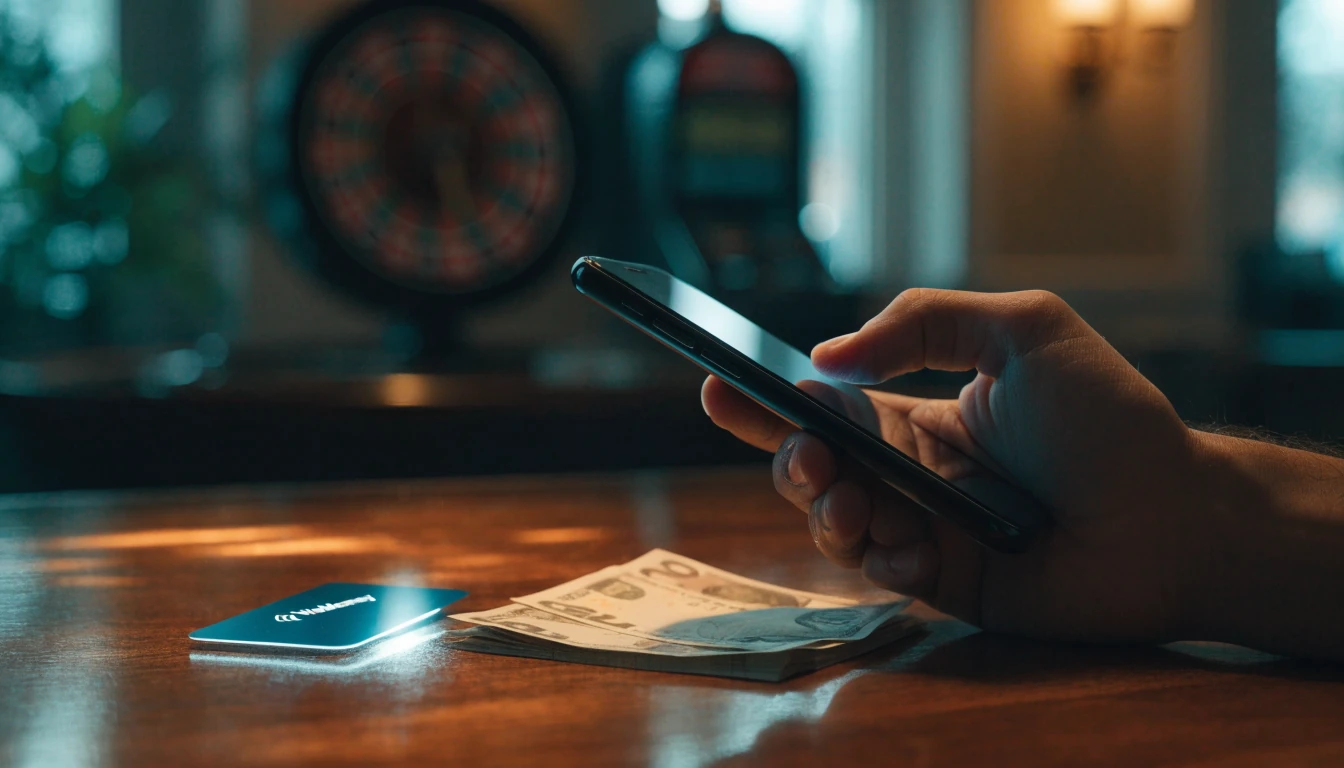
That is the narrow point. An intermediary changes the route, not the nature of the original payment—and not the evidence about cheque acceptance.
What can—and cannot—be confirmed about cheque deposits
A bank cheque and a casino deposit charged to a mobile account belong to different payment systems. The latter is Pay by Phone: a player authorises a charge through a mobile number, and the cost is added to a phone bill or deducted from prepaid credit. That description does not establish that a casino accepts cheques.
This distinction matters because payment labels can blur together in casual descriptions. A service that lets someone fund a gambling account without entering card details may sound like a route through a bank, but Boku is not a cheque-clearing service. Nor does an operator’s acceptance of Boku imply acceptance of a bank-issued cheque.
The rules surrounding casino licensing answer a separate question. A UK Gambling Commission licence concerns an operator’s authority to offer gambling in Great Britain; it is not a statement about every payment method available at its cashier. Payment options are operator-specific, and a method must be identified on its own terms.
So the careful answer to whether a UK online casino accepts a bank cheque is narrower than a list of Pay by Phone sites would suggest. Boku and other mobile-payment services can be described as such, but their presence says nothing decisive about cheque deposits. A cheque should not be treated as accepted unless the casino itself explicitly confirms that method and explains how it is handled.
That is the boundary between a payment fact and an assumption. Mobile billing is documented as mobile billing. A bank cheque remains a separate claim, not a synonym, workaround or implication.
What are the deposit limits at pay by mobile casinos?
Boku deposits are generally limited to about £10 per transaction and £30 per day at network level. The standard UK casino limit is £30 per transaction, though some casinos or network operators may allow up to £40 or £50; PAYG deposits are also capped by your remaining phone credit.
Are Boku casinos still available in the UK in 2026?
Yes, a small number of UKGC-licensed casinos still accept Boku, although the list has been shrinking since 2023. Some operators have switched to alternatives such as Fonix or Siru Mobile.
Can I deposit by phone bill without Boku?
Yes. Some UK casinos support other phone-billing options, including Fonix and Siru Mobile.
What is the standard Boku deposit limit in the UK?
The standard limit is £30 per transaction, although some casinos or mobile networks may permit up to £40 or £50. Network-level limits are typically about £10 per transaction and £30 per day.
Are Boku deposits eligible for casino bonuses?
Bonus eligibility varies by operator. Boku deposits generally do not come with specific bonuses, while some casinos accept other pay-by-phone deposits for bonus eligibility.
Why are UK casinos dropping Boku?
Operators have dropped Boku because of compliance risk. No UK Gambling Commission rule specifically banned Boku.
How to deposit with Boku at online casinos?
Select Boku in the casino cashier, enter an eligible deposit amount and your phone number, then confirm the payment using the SMS verification code. Deposits are charged to your monthly phone bill or deducted from your PAYG credit.
Written by the editors at Nine Casino 2.