Online European Roulette in the UK: Rules and Odds
 Available in GB
Learn how the single-zero wheel shapes bets and odds, and how online formats and live tables affect the roulette experience.
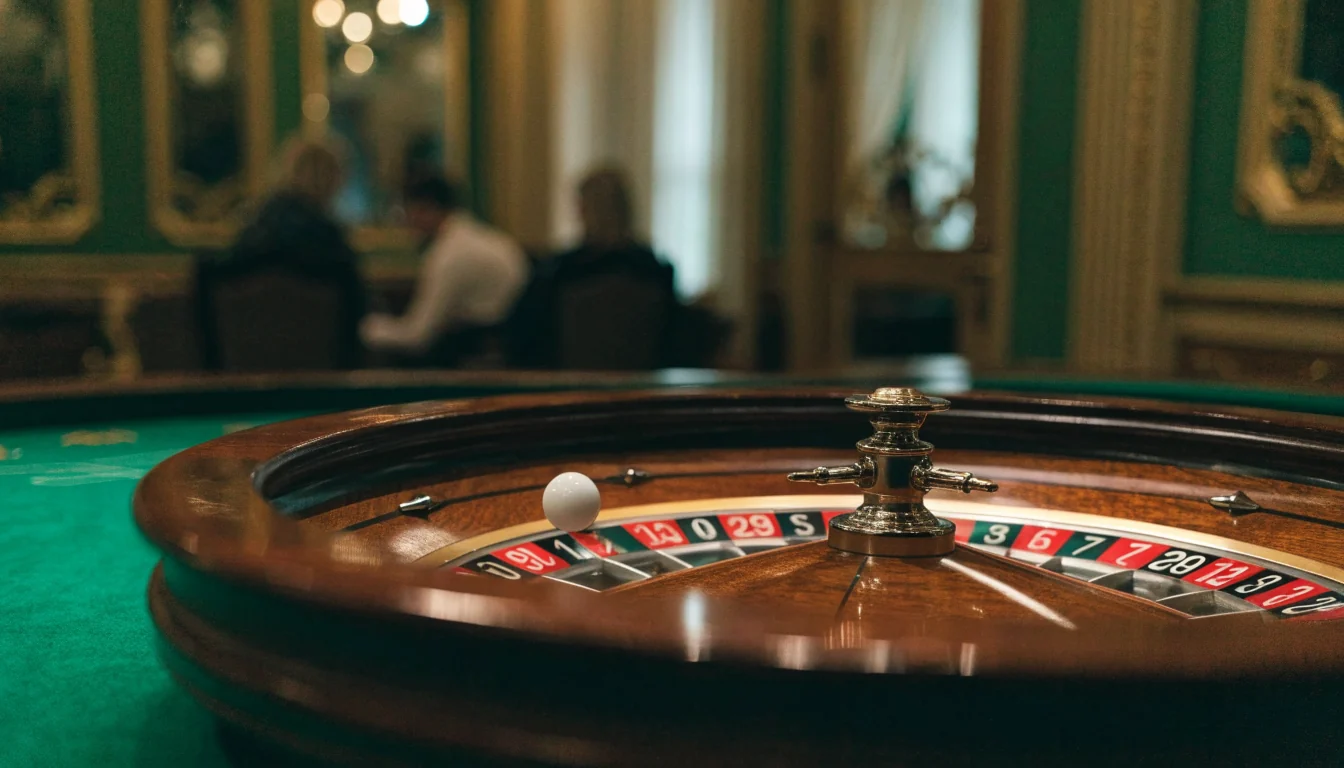
Table of Contents
- The European Wheel and Its Single Zero
- What Makes a Roulette Table Worth Choosing
- The Bets, and What They Pay
- RNG, Speed and the Shape of an Online Table
- Single-Zero Tables, Bets and the Limits of a System
- Free Spins, Real Money and the Small Print
- Reading the Roulette Table Layout
- Roulette Slots: A Different Kind of Game
- The Live Dealer, the Studio and UK Safeguards
- European and American Roulette: The Extra Zero
The European Wheel and Its Single Zero
European roulette is built around a compact inventory: 37 pockets, numbered from 1 to 36, with one additional pocket marked zero. The ball settles in one of them, and that result determines the round. Its defining feature is not the colour of the wheel, the speed of the ball or the ceremony around the spin. It is the single zero.
That pocket gives the game its mathematical character. The numbered outcomes are not the whole field; zero is part of it, too. A wager on a numbered result therefore faces a set of possible outcomes that includes a pocket beyond the numbers from 1 to 36. The same principle shapes the game more broadly: every spin ends in one pocket, while the casino’s advantage is built into the odds attached to the possible results.
The house edge for European roulette is 2.70%. This is a measure of the casino’s theoretical advantage over time, not a prediction of what will happen in a particular round. A single spin can produce any pocket, and a short session can look nothing like the long-run mathematics. The figure describes the structure of the game across repeated play; it does not promise a particular outcome or a steady sequence of losses.
When looking for European roulette online in the UK in 2026, payout timing is one practical detail to check alongside game availability and other terms. This list notes the payout information available for each operator.
Payout speed: 1-3 business days WinBeast lists a payout speed of 1–3 business days.
Payout speed: 1-3 business days SpinFormula lists a payout speed of 1–3 business days.
Payout speed: 1-3 business days EvoSpin lists a payout speed of 1–3 business days.
Payout speed: 1-3 business days Britsino lists a payout speed of 1–3 business days.
Payout speed: 1-3 business days Amunbet lists a payout speed of 1–3 business days.
Payout speed: 1-3 business days BeOnBet lists a payout speed of 1–3 business days.
Payout speed: 1-3 business days Chanze lists a payout speed of 1–3 business days.
Payout speed: 1-3 business days Dieselwin lists a payout speed of 1–3 business days.
Payout speed: 1-3 business days NightLuck lists a payout speed of 1–3 business days.
Payout speed: 1-3 business days NightWin lists a payout speed of 1–3 business days.
That distinction matters because roulette presents chance in a highly legible form. The wheel turns in public view, the ball travels a visible path, and the result is announced without ambiguity. A number appears. The apparent clarity of the event can make its underlying uncertainty feel smaller than it is. In fact, the result of each spin remains uncertain until the ball comes to rest.
The zero is visually modest but mathematically decisive. Without it, the numbered outcomes would make a different game. Its presence changes the relationship between the field of possible results and the wagers made against them, giving the casino its edge. The single green pocket is not an ornament added to a numbered wheel; it is part of the calculation that makes European roulette what it is.
This is why the phrase “European roulette” matters when comparing online tables. It identifies a wheel with one zero, rather than simply a game with a familiar name or appearance. Online, a polished interface can make different versions seem interchangeable, but the pocket count is a basic distinction. In an online casino, the game’s title and rules should correspond to the wheel actually being offered.
The casino setting changes how the game is delivered, not the basic logic of the wheel. In European roulette online, the animation may be digital or the action may be presented in another format, but the version described here still rests on the same 37 possible pockets and the same single zero. The screen can soften the machinery into colour and motion. The arithmetic remains unsentimental.
A house edge is also not the same as a charge taken from every wager at the moment it is placed. It is a statistical measure of how the rules favour the house over repeated play. Individual results vary; the edge does not dictate the next result. A run of outcomes can feel persuasive, especially when each one arrives in sequence, but the wheel has no memory in the ordinary sense. A previous result does not make a later pocket due.

There is a small social history embedded in the arrangement, even without knowing who first settled on its exact form. Games of chance turn uncertainty into something that can be watched, named and organised. Roulette does so with a wheel, a ball and a numbered field. The casino supplies the setting and the rules; the player supplies attention, expectation and, often, an interpretation of patterns that the mathematics does not require.
For anyone comparing European roulette casinos in the UK, the useful starting point is therefore not atmosphere but the wheel’s defining fact: one zero among 37 pockets, with a 2.70% house edge. That is the baseline. Other rules and table arrangements can alter the terms of play, but the single-zero wheel is the foundation on which this version rests.
Its simplicity is deceptive. A result is easy to identify; the odds are less easy to feel. One spin seems to invite a story, and the next can appear to confirm it. Yet the wheel offers no plot, only a set of possible pockets and a chance-based outcome. The zero sits among them, quiet and consequential.
A clean mechanism. A lasting uncertainty.
What Makes a Roulette Table Worth Choosing
The wheel tells only part of the story. Two tables can both be labelled European roulette and share the same basic arrangement, yet offer different terms when the ball lands on zero. That distinction matters most to players choosing between standard European rules and a French table with La Partage or En Prison.
On a standard European table, the house edge is 2.70%. It comes from the zero: an outcome that can defeat wagers covering red or black, even or odd, and high or low. La Partage changes what happens to those even-money bets. If zero appears, half the stake is returned rather than the entire wager being lost. Under that rule, the house edge on those bets falls to 1.35%.
The reduction is specific, not universal. La Partage applies to even-money bets; it does not make every wager on the table carry the lower edge. A table’s headline variant therefore cannot tell the whole story. The printed rules matter, and so does the kind of wager being considered.

There is a small social history in that half-return. The casino keeps its advantage, but concedes that a zero need not collect the whole stake from every player at once. It is not generosity; it is a rule that changes the arithmetic in a defined situation. Still, in a game built around a house advantage, a defined concession is worth noticing.
French roulette goes further. Its La Partage and En Prison rules give it the lowest house edge among standard roulette variants. La Partage returns half of an even-money stake after zero. En Prison treats the wager differently: instead of settling it as a loss, the stake is held for the next spin, where it may be resolved according to the table’s rules. The exact wording on the table is important, since rules determine what happens to that imprisoned stake.
These rules can make a French table a more favourable choice for even-money betting than a standard European table. They do not turn roulette into a game with a predictable result, nor do they remove the house advantage. They alter the cost of particular outcomes. That is a narrower claim, and a more useful one than calling any table simply “the best.”
A sensible comparison begins with the rule panel, not the name of the game. It should state whether La Partage or En Prison applies and which wagers qualify. If the wording is absent or unclear, the label “French” is not enough to establish the terms. Tables may present familiar layouts while differing in rules, and the difference can be easy to overlook when attention is fixed on the wheel.
The next distinction is between a better rule and a better fit. A player who favours even-money bets has a direct reason to look for La Partage or En Prison. Someone choosing other kinds of wagers should not assume that those rules lower the edge on every part of the table. The benefit belongs to the eligible bets, not to the table as a magical whole.
House edge is 2.70%. Even-money bets are lost if the ball lands on zero.
House edge on even-money bets falls to 1.35% because half the stake is returned on zero.
Lowest house edge among standard variants, utilizing both La Partage and En Prison rules.
Online, the same scrutiny applies before play begins. The table information should explain the variant and its special rules, while the game itself should make clear how a qualifying wager is treated after zero. A polished screen does not improve the odds. The rule text does the work.
There is no need for a league table of casinos to make this comparison meaningful. The practical question is whether the available roulette table states its rules plainly and whether those rules suit the intended wager. Under standard European rules, the edge is 2.70%; on eligible even-money bets with La Partage, it is 1.35%; French roulette, with La Partage and En Prison, has the lowest edge among standard variants.
Small print, large consequence.
The Bets, and What They Pay
A roulette wager is defined by the result it covers. A bet on one number offers a narrow target and a larger payout; a bet covering a broader set of outcomes pays less when it wins. On an online European roulette table, the same distinction applies whether the selection is made on a digital layout or through a live dealer interface.
The most focused inside bet is the straight-up: a chip placed on a single number. If that number wins, the payout is 35:1. The same stated payout applies to a straight-up bet on European and American roulette. A split covers two adjacent numbers, with the chip placed across their dividing line; it pays 17:1 if either number wins. A street bet covers a horizontal row of three numbers and pays 11:1 when the ball lands on one of them.

These bets trade coverage for return. A single-number wager can miss easily because it depends on one result, while a split or street gives the bet more numbers to cover and pays at a lower rate. The payout is attached to the winning selection, not to how often a player has previously won or lost.
Outside bets cover broader categories. Red or black, even or odd, and high or low each pay 1:1. A player chooses one side of the category, and the wager wins if the result falls within it. The payout is more modest than for an inside bet because the selection covers a wider group of outcomes.
The ratio describes winnings relative to the stake: a 35:1 winning straight-up bet earns thirty-five units for each unit staked, with the original stake also returned. The corresponding convention applies to the other listed ratios. A losing wager is lost; the quoted payout is not a promise that the chosen result is likely.
A simple way to approach play is to decide first what kind of outcome the wager should cover. A single number is a precise choice; a split or street broadens that choice; an outside bet follows a colour, parity or range. Each has its own payout, but none changes the wheel’s result. Choosing a smaller payout does not make a win certain, and selecting a high payout does not make a number more likely to appear.
For anyone learning how to play European roulette, the useful distinction is therefore between the selection and its return. The selection determines which result counts as a win. The payout states what the table pays if that result occurs. Before placing a wager online, the displayed rules and paytable show the terms attached to that table; those details matter more than the name given to a particular style of play.
Straight-Up Bet
Example: 35:1 × 1 unit = 35 units profit (plus original stake returned).
The arithmetic is plain. The temptation is not.
RNG, Speed and the Shape of an Online Table
An online European roulette table can be built around a simulated spin, an automated physical wheel or a faster sequence of rounds. The wheel’s familiar green zero may remain part of the game, but the way each format produces a result changes the pace and the minimum stake available. A screen can make these distinctions look cosmetic. They are practical.
With RNG roulette, software uses a random number generator to produce each simulated spin. There is no physical ball to watch; the result appears on screen and the next round can begin quickly. That makes this format suited to short, uninterrupted play, while lower minimum stakes can make it accessible to people who do not want to commit much to a single round. Stakes can be as low as 10p, though the available minimum depends on the table.
Auto-roulette keeps the physical wheel but removes the dealer from the immediate process. The wheel spins automatically, with the betting interface alongside it. This is a middle ground: the movement of a real wheel remains visible, but there is no need to wait for a dealer to operate each round. The distinction matters less as theatre than as rhythm. A simulated result is brisk; an automated wheel gives the spin a visible, mechanical interval.
Minimums are not uniform across online casino tables. A specialist review of UK roulette formats reports that live tables can begin at 10p, while auto-roulette and speed roulette formats sometimes start at 5p. These are reported table options, not a promise that every operator offers them. The small print is plain: the table selected determines the entry stake.

Speed roulette compresses the interval between rounds. A specialist review reports more than 150 spins per hour for this format, compared with 80–100 at a standard table. The figures describe a materially quicker rhythm, not an advantage in predicting results. More rounds mean less time between decisions; they do not make any individual outcome more knowable. Speed is a feature of the schedule, not of the odds.
The choice, then, is partly about how much waiting a player wants built into the experience. RNG play removes the physical interval altogether. Auto-roulette retains a wheel but automates its operation. Speed roulette accelerates the round cycle. Each can be found among online European roulette options, though table names and minimum stakes vary by operator.
A lower entry point can make a table easier to approach, but a faster one can also make spending accumulate more quickly simply because decisions arrive sooner. The interface does not slow itself down on behalf of a player. That is the less glamorous design feature.
These formats should not be confused with live dealer roulette, where a streamed studio, human dealers and physical ball drops shape the experience. Here the useful distinction is narrower: simulated, automated or accelerated play. None changes the underlying character of roulette as a game of chance. The table changes its tempo. The result remains uncertain.
Single-Zero Tables, Bets and the Limits of a System
On a European roulette table, the single-zero wheel gives the betting choices their common point of reference: every wager is settled against the same numbered pockets, including zero. Players can place inside bets on particular numbers or small groups, or choose outside bets covering broader outcomes. The distinction is not merely visual. It is a choice between concentrating a stake on a narrow possibility and spreading it across a wider one.
- Choose wagers based on desired risk and payout
- View the house edge as a statistical constant
- Use systems like Martingale to predict results
- Assume a winning or losing run influences the next spin
That choice can make a session feel more or less exposed, but it does not alter the wheel. A wager on a single number and a wager on a broad outside category are different ways of engaging with the same uncertain result. The European roulette house edge is 2.70%, a mathematical feature of the game rather than a forecast of what will happen in an individual spin. A run of wins does not prove that a pattern has emerged; a run of losses does not mean the wheel is due to correct itself.
This is where betting systems acquire their appeal. They turn uncertainty into a procedure, and a procedure can feel like control. The Martingale is the clearest example: after each loss, the player doubles the next bet, intending to recover earlier losses if a win eventually arrives. Its arithmetic is easy to follow. Its promise is less sturdy.
A winning result may indeed interrupt a losing run. But no roulette strategy can predict the final outcome, because the odds are determined by chance. Changing the size of a stake changes the amount at risk; it does not give the next spin a memory or make a particular pocket more likely to appear. The system manages money according to a rule. It does not manage probability.
The danger is that doubling makes each successive decision more consequential. A losing streak can push the required stake higher and put increasing pressure on a bankroll. The approach depends on having enough funds to keep following its own instruction, while chance offers no assurance that a win will arrive at the convenient point. A sequence that began as a modest attempt to recover losses can therefore become a larger commitment to the same uncertainty.
There is also a human cost in the way the system frames a loss. Instead of treating it as a completed wager, the player may see it as a debt that the next spin ought to repay. But the wheel owes nothing. The single zero is not a signal, a warning or a promise of balance; it is one of the outcomes against which bets are settled.
Inside and outside bets remain meaningful choices because they shape the kind of risk being taken. They can suit different appetites for narrow or broad outcomes, but neither category supplies foresight. The useful distinction is between choosing a wager and believing that a sequence of wagers can force chance to behave. It cannot.
A system can organise a session. It cannot make the wheel predictable.
Free Spins, Real Money and the Small Print
A free European roulette demo and real-money play may look much the same on screen, but they serve different purposes. Demo mode uses no cash stake and offers no cash winnings; it lets a player try the game without putting money at risk. Real-money European roulette involves deposits and the possibility of losing the amount staked. The distinction is not cosmetic. A balance shown in a demo is not a withdrawable prize.
Attention: A balance shown in a free demo mode is not a withdrawable prize and involves no real cash stake.
“Free spins” can also be an imprecise label in casino promotions. Roulette is played through wagers on a wheel, not spins on a slot reel. A promotion may provide bonus funds for casino games, but whether roulette qualifies—and whether any resulting balance can be withdrawn—depends on its terms. A roulette demo should not be confused with an online slot demo either: the products have different rules and promotional conditions.
The small print matters because roulette wagers may count only partly toward a bonus wagering requirement. Across UK operators, roulette is commonly assigned a game weighting of 10% to 20%. In practical terms, only that share of an eligible wager is counted towards the requirement; the rest does not help clear it. The rate varies between operators and can also depend on whether the game is RNG or live. Specialist reviews report examples in which live roulette counts at 10% or 20%, while RNG roulette counts at 100%; those figures describe reported operator terms, not a uniform rule.
No-deposit offers can be narrower still. Some operators exclude live roulette from wagering altogether; specialist reviews report that, where it is included, its game weighting can fall between 0% and 10%. The promotion’s own terms are decisive. A headline bonus does not reveal which games count, how much each contributes, or whether particular roulette formats are excluded.
A further rule changed in January 2026: UK regulations now cap bonus wagering at a maximum of 10x for licensed operators. That cap limits the stated wagering multiple, but it does not make every offer equally easy to use. Game weighting still determines how much eligible play counts, and other conditions may govern which games qualify and what happens to bonus funds.
For real-money play, the operator must hold a current UK Gambling Commission licence to serve the British market. Game information should also make RTP accessible, alongside the bonus terms; neither should be inferred from a promotional headline. Reading the rules is less glamorous than watching the wheel, but it is where the offer becomes legible. The fine print has the house style.
Reading the Roulette Table Layout
A European roulette table shows two arrangements side by side: the wheel, with its pockets, and the betting layout, where chips are placed. They are related, but they do not mirror each other. The wheel has 37 pockets—numbers 1 to 36 and a single zero—while the cloth groups the numbered choices into a grid and betting areas.
On the layout, the numbers sit in three columns of twelve. Each number has its own space, making a straight-up wager easy to recognise: the chip goes directly on that number’s square. A chip placed on a boundary can cover neighbouring numbers, while one on a junction can cover several. The position matters; a chip that slips from a square to a line changes what is being covered.
The zero is set apart from the numbered grid, often in a green space at one end. That visual separation reflects its role in the game: it is neither red nor black, neither odd nor even, and belongs to neither the low nor high group. The cloth is not a picture of the wheel’s physical sequence. It is an index for bets.
Beyond the grid are the outside-bet boxes. Red and black appear on opposite choices, alongside even and odd, and the low and high groups. These broad selections are easier to spot than a single number, but they still depend on the same pocket landing under the ball. Red/black, even/odd and high/low wagers pay 1:1. Their position around the grid makes the distinction between a specific number and a broad category legible at a glance.
A European roulette casino table layout can vary in screen design, especially online, but the underlying map is familiar: numbered squares in the centre, wider choices around them, and zero apart from the numbered columns. Digital tables may highlight a selected area or show the chip value beside it. Those signals help show what is currently covered; they do not alter the wheel or improve the odds.
Reading the cloth is therefore less a matter of strategy than of locating the wager before a spin begins. The grid answers “which number?” The outer boxes answer “which group?” The wheel supplies the result, without regard for how neatly the table has arranged its choices. A tidy diagram. Chance remains untidy.
Roulette Slots: A Different Kind of Game
A roulette theme does not make a slot a roulette table. On a wheel, a ball settles into a numbered pocket and the result follows the game’s roulette rules. A slot uses reels and its own game design. Images of a wheel, a green zero or a casino floor may borrow roulette’s visual language, but they do not turn the reels into a wheel.
That distinction matters when terms such as three-dimensional European roulette appear in a game description. The label may suggest a more immersive presentation, but it does not establish that the game reproduces European roulette’s mechanics or odds. Nor do “gold” and “platinum” labels, when attached to themed slot searches, by themselves tell anything reliable about how a game works. The title and theme are not a rulebook.
The same caution applies to familiar names. Book of Dead is a slot, not a roulette variant: its name belongs to a separate game built around reels. XXXtreme Lightning Roulette is also a named product, not a conventional roulette table merely because roulette appears in its title. A title can borrow the theatre of another game while remaining a different product altogether.
So-called European roulette odds belong to roulette played on a wheel with its own pockets and wagers. They cannot simply be carried across to a roulette-themed slot. A slot’s rules and outcome mechanics must be read as those of that individual game; its artwork cannot supply missing information. The resemblance is a costume, not a mathematical relationship.
There is a broader difference in the way the games stage chance. Roulette makes the decisive moment visible: the wheel turns, the ball travels, and the result arrives at a pocket. A slot presents its result through reels and symbols. One borrows the ritual of the casino table; the other uses the familiar grammar of spinning reels. Neither appearance, by itself, says what the odds are.
British rules also distinguish online slots from the older, faster rhythm of clicking through repeated spins. Autoplay is banned, and each online slot spin must last at least 2.5 seconds. Those restrictions apply to slots, including themed ones; a roulette-like title does not become exempt by dressing itself as a table game.
The label can be vivid. The category still matters.
Legal Compliance
Operators serving British customers must hold a valid UK Gambling Commission licence; platforms without one cannot legally offer real-money roulette in the UK.
The Live Dealer, the Studio and UK Safeguards
Live European roulette replaces a generated spin with a physical event. A camera streams a studio, where a human dealer sets the wheel in motion and releases the ball. The result is still governed by chance, but the wheel, dealer and ball drop are visible rather than simulated by a random number generator. That distinction gives the game a more social surface; behind the glass, it remains a wager.
A live European roulette casino experience depends on the quality of that stream as much as on the table itself. The dealer calls the stages of play, the camera follows the wheel and the ball’s final resting place determines the result. It is a small performance repeated to a schedule, with the studio turning routine into spectacle. No audience participation is required.
For real-money play in Great Britain, the legal distinction is sharper. The UK Gambling Commission is the sole regulator of online casino activity there. Operators serving British customers must hold the relevant UKGC licence; a platform without a valid UKGC licence cannot legally offer real-money live roulette to British residents. The licence can be checked on the Commission’s public register before depositing.
Safeguards are part of that licensed arrangement, not optional decorations. Operators must verify age before allowing a customer to deposit. They must prompt new customers to set a financial limit before the first deposit, and provide accessible account-level controls. UKGC-licensed live casino operators must offer deposit and loss limits, session reminders and reality checks, cool-off periods, and GamStop self-exclusion. Credit cards cannot be used to fund gambling.

Game information matters too: RTP information must be accessible for roulette offered by UKGC-licensed operators. A stream can make a table feel transparent, but a visible ball does not explain the terms of play or replace the protections around an account. UKGC licensees must also provide an internal complaints process and access to an approved Alternative Dispute Resolution service.
The studio supplies theatre; regulation supplies the boundaries. Neither makes chance predictable.
European and American Roulette: The Extra Zero
The clearest difference between European and American roulette is not a change in colour or ceremony. It is the extra pocket. A European wheel has 37 spaces: numbers 1 to 36 and one zero. The American version adds a double zero, making 38. That additional green space changes the odds across the table.
On a standard European wheel, the house edge is 2.70%; on an American wheel, it is 5.26%. The game still presents familiar numbers and colours, but the extra pocket means a wager has a slightly smaller chance of landing on a winning result. The difference is built into the wheel, not added by a dealer or a particular betting style.
One American wager is more affected than the general figure suggests. The basket bet, which covers the first five numbers, carries a house edge of 7.89%. It is therefore not simply another way to cover several numbers: its terms make it less favourable than the overall American-wheel edge. The green spaces are doing their quiet work.
A further variation appears on some UK online tables. A specialist review reports American wheels with a third green pocket marked 000, giving that version a house edge of 7.69%. This should be treated as a feature of the tables described, not as a standard feature of American roulette. The game’s label alone does not reveal every pocket on the wheel.
For anyone comparing an online European roulette game with its American counterpart, the pocket count is the useful first check. A single zero leaves the European wheel with the lower house edge; a double zero raises the American one, and the basket bet has a higher edge again. The distinction is small in appearance and substantial in arithmetic.
Roulette has long made chance look orderly: numbers in rows, colours divided into camps, a wheel turning with the air of a decision. The extra zero is a reminder that the arrangement is not the advantage. The arithmetic is.
Prepared by the Nine Casino 2 editorial staff.